Register
Recordings and repertoire of British light music, and what survives
The 78s, the library pressings and the reissue programmes through which almost all of this music now reaches a listener.
Most of this repertoire is available today because collectors kept discs that the companies who made them discarded, and because specialist labels later paid engineers to transfer them. The entries here cover what survives and in what condition, and the body of songs that the bands and orchestras were actually playing.
Where the music actually is
Three kinds of source hold this repertoire, and they are not equally easy to search.
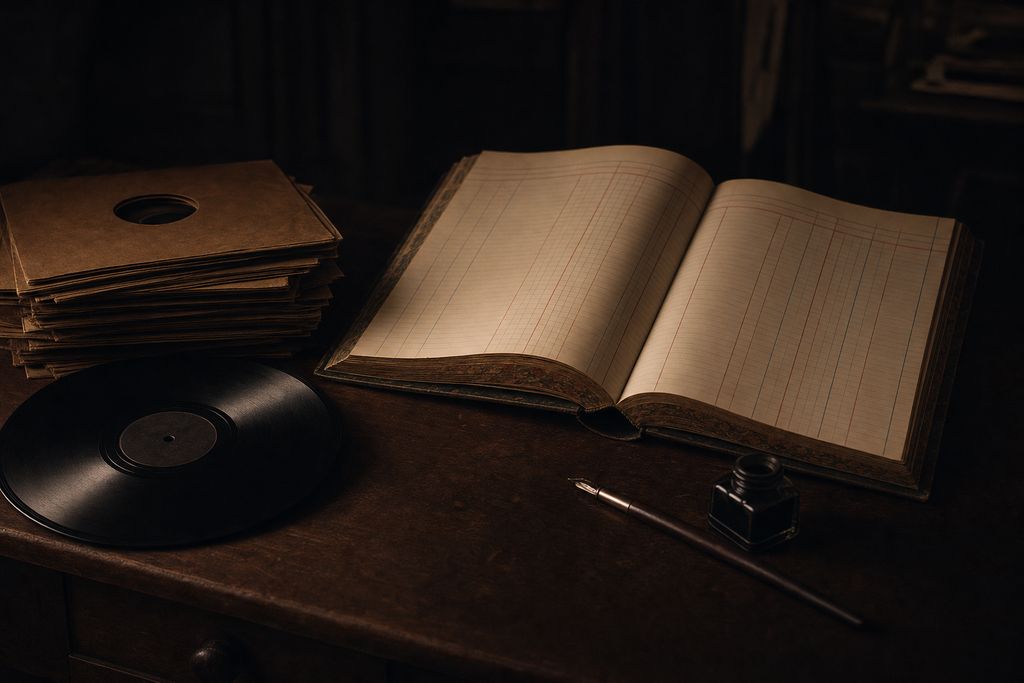
Commercial discs, 78rpm shellac before about 1950 and vinyl afterwards, hold the pieces that were issued for sale while they were current. These are the easiest to find and the smallest part of the whole. Publishers' library pressings hold a much larger body of work that was never on sale to the public: recorded at the publisher's expense, indexed by mood and duration, and licensed to film, newsreel, radio and television producers. Almost nobody kept them, because they were working tools rather than products. And LPs from the 1950s onwards carry the orchestral albums made by named conductors and bandleaders, where the credit is on the sleeve.
A piece can therefore have been heard by millions and never have been purchasable, which is the normal condition of library music and the reason a handful of surviving pressings in private hands is sometimes the only source that exists.
Four kinds of recorded source, and how to tell them apart
Almost every question about a light-music recording turns out to be a question about which of four things you are holding, because they were made for different buyers and documented to different standards.
A commercial issue was sold to the public: a 78, later an LP, with a catalogue number, a label credit and a release date somebody had a commercial reason to record. These are the best documented and the smallest group.
A publisher library disc was never sold. It was pressed in small numbers and sent to producers who selected from an index describing mood, action and duration, and it carries a publisher reference rather than a release date. Credits on them are abbreviated, replaced by house names or absent. This is the largest group and the least traceable, and it is where most of the attribution problems on this site come from.
A broadcast recording was made to be transmitted, not kept. Where one survives it is usually because an individual kept a copy rather than because an institution did, and the surviving fraction of what was played live on air is very small.
A modern reissue is a transfer of one of the above, and it is a reading of the source rather than a neutral copy: two competent restorers produce two different-sounding transfers of the same side. It is also, frequently, the only place the recording date appears in print.
The practical consequence is that a citation needs to say which of the four it means. "Recorded 1953" can be a session date from a surviving sheet, a catalogue date encoded in a publisher reference, or a compiler's estimate, and those are three different claims.
Reading a reissue booklet
The specialist reissue programmes that began in the 1990s are the practical route into this material, and their booklets are primary sources rather than packaging. An engineer preparing a transfer has to establish what a recording is, which means working through a publisher's or a collector's archive with the discs and the paperwork together. Session dates, personnel and catalogue numbers printed in a CD booklet are frequently the first time that information has appeared anywhere.
Two cautions follow. A booklet does not always distinguish between a date read off a session sheet and a date inferred from a matrix number, and where two booklets disagree they are usually both reporting honestly from incomplete evidence. Treat them as good scholarship without an apparatus, which is what they are.
What a transfer decides for you
A transfer is a sequence of judgements, not a mechanical operation, and the result depends on them. The engineer chooses a stylus profile for a groove cut to no consistent standard, reconstructs a replay equalisation curve that was often never published, and then decides how much surface noise to remove. That last choice is the consequential one: aggressive noise reduction takes high-frequency musical content with the hiss, and an over-treated transfer sounds clean and lifeless.
Practice has moved towards leaving noise in, so some transfers from the 1990s are now regarded as having been processed too hard. If you compare two transfers of the same recording and prefer one, what you are hearing is a set of decisions rather than the record itself.
- 1920s jazz standards The repertoire British dance bands actually played
- Sound restoration Transfer and restoration: the reason this repertoire is audible at all
- The recorded legacy What survives on record, and what has been lost
Frequently asked questions
What does this register cover?
Recordings that carry the repertoire — commercial releases, library discs and broadcast material — with the details that make a recording identifiable rather than just named.
Why is the recording date more useful than the release date?
Because the players, the room and the arrangement belong to the session. A release date can be years later and tells you about a marketing decision instead.
What is a matrix number?
The identifier stamped in the run-out groove, assigned when the master was cut. It survives changes of label, catalogue number and sleeve, which is why a discography leans on it.
Why do reissues sometimes credit a different arranger?
Because a reissue is compiled from whatever paperwork the current rights holder has, and that is often not the session paperwork. A credit added decades later is a claim, not evidence.
How much of this repertoire is available now?
More than at any point since it was made, through reissue programmes that began in the 1990s — but selectively, and weighted towards what somebody judged saleable.
Why is some of it only audible because of restoration?
Because the surviving copy is a worn disc or a degraded tape. What is heard on a modern reissue of that material is a reconstruction, and a good one says so.
Do streaming credits match the original labels?
Often not. Streaming metadata is inherited through a chain of hands, and the arranger — who decided most of what a listener actually hears — is the field most likely to be missing.
What is the difference between a session and a release?
A session produces masters; a release selects from them. More than one release can come from a single session, and a master can sit unissued for years or forever.
- Sources
- Checked
- REF/HUB-RECORDINGS · 3 sources