Sources and survival
The recorded legacy of British light music, and what has been lost
Most of this repertoire exists today because individual collectors kept discs that the companies who made them threw away, and because somebody later paid to transfer them.
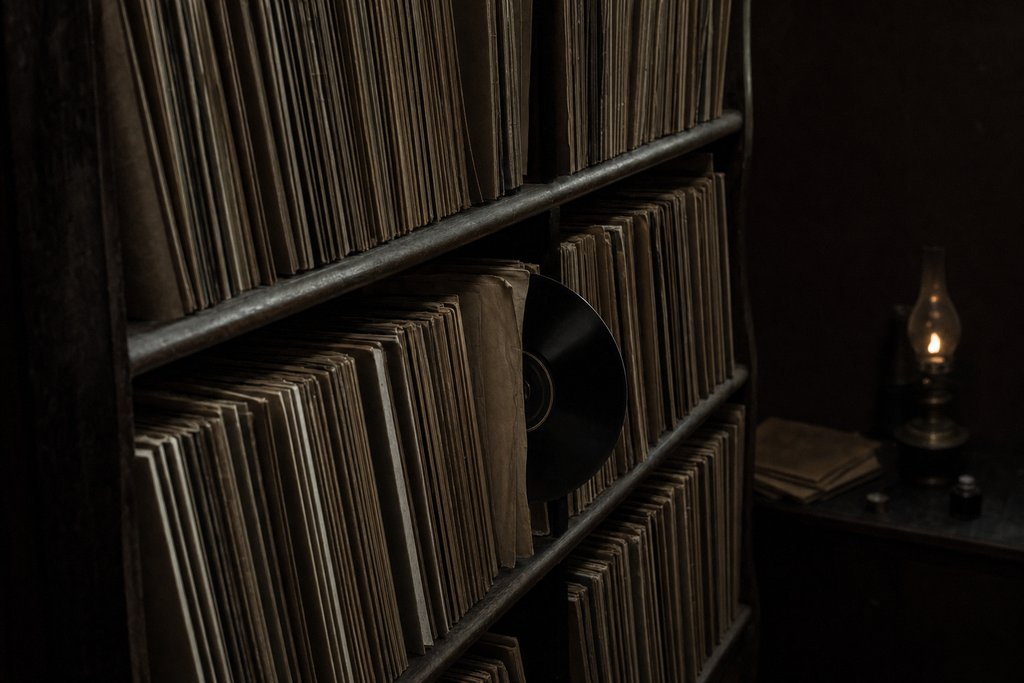
A repertoire that survives by accident
Almost everything discussed on this site is available today for a reason that has nothing to do with institutional preservation. Individual collectors kept discs, and specialist labels later paid engineers to transfer them.
That is worth stating at the outset because it explains the shape of what exists. There was no national archive systematically collecting British light music, no publisher treating its own library as a heritage asset, and no broadcaster retaining its output on the assumption that somebody would want it. The music was commercial product with a working life, and when the working life ended the product was disposed of.
What survived did so because somebody outside the industry thought it was worth keeping.
Three media, three failure modes
The physical carrier determines survival, and each of the three main carriers fails differently.
Shellac 78rpm discs hold everything before about 1950. Shellac is brittle: a dropped disc is destroyed rather than damaged, and a century of storage has broken a large proportion of what was pressed. The material also has high intrinsic surface noise, which is why transfers of this era always involve a decision about how much of the noise to remove and what to sacrifice with it.
Vinyl pressings, covering library discs and LPs from the 1950s onwards, wear rather than break. A library disc that spent fifteen years in a production office has been played with whatever equipment was to hand, frequently badly, and groove wear is cumulative and irreversible.
Magnetic tape holds later studio material and looked like the durable option for decades. Some tape stock manufactured in the 1970s and 1980s degrades chemically, the binder breaking down so that the coating sheds and the tape becomes unplayable without specialist treatment. Recordings made most recently are in some cases at greater risk than recordings made in 1935.
Why library discs are the scarcest
Of the three, library pressings are the hardest to find, and the reason is that nobody was ever supposed to keep them.
A library disc was not a product for sale. It was a tool, pressed in small quantities and sent to production offices with a catalogue. It was played to find a cue, played again to time it, and played again in the dub. When the library issued a new volume the old one occupied shelf space that the office needed, and it went in the bin.
Publishers were not much better custodians. The commercial value lay in current catalogue and in the licensing rights, not in the physical objects, and masters were frequently not retained once a title had stopped earning. The consequence is that for a substantial part of the repertoire described under British light music, a handful of surviving pressings in private hands is the only source that exists.
What a transfer actually involves
The word “transfer” suggests a mechanical operation. It is a sequence of judgements, and the result depends on them.
The engineer begins by choosing a stylus. Groove dimensions on 78s were not standardised across companies or across decades, so a profile that sits correctly in the groove of one label rides badly in another, picking up wall damage instead of the signal. Getting this wrong adds noise that no amount of later processing removes.
Next comes replay equalisation. Records were cut with a frequency curve applied, and it has to be reversed on playback. For much of the 78 era the curve used by a given company at a given date was not published, and in some cases is not now known, so the engineer is reconstructing it by ear against a plausible orchestral balance.
Then the noise. This is where the real argument lies. Surface noise can be reduced substantially, but the processing that removes hiss also removes high-frequency musical content, and an over-treated transfer sounds clean and dead, with the top of the string sound and the air around the orchestra gone. Practice has moved towards leaving noise in, and some reissues from the 1990s are now regarded as having been processed too hard.
Two engineers working conscientiously from the same disc will produce audibly different results. If you compare two transfers of the same recording and prefer one, you are hearing a set of decisions rather than the record.
Who did the work, and what that skewed
The reissue programmes that recovered this repertoire began in earnest in the 1990s and were run by specialist labels, in more than one case built around individual enthusiasts working from their own collections.
This has an obvious and important consequence. The coverage is not a survey. It reflects what particular collectors owned, what they thought mattered, and which composers had somebody prepared to make the case for them. A composer with an advocate has been recorded thoroughly. A composer without one may be represented by two pieces on a compilation, or by nothing, regardless of how good he was or how much he wrote.
Anybody using the available recordings as evidence of the shape of the repertoire should therefore be careful. The discography reflects the history of collecting at least as much as it reflects the history of the music.
The broadcasts that were wiped
Alongside the commercial recordings sits a much larger body of performance that mostly does not survive.
The BBC’s house orchestras played continuously for decades, and the great majority of what they played went out live and was never recorded. Where it was recorded, tape was expensive, storage was finite, and the corporation reused stock as a matter of routine. Wiping was not vandalism but housekeeping, carried out by people with no reason to think that a Tuesday afternoon light orchestral programme would be of interest in fifty years.
The gaps this leaves are not evenly distributed. Programmes with a continuing identity were more likely to be kept than routine schedule filler, so the survival rate is highest for exactly the material that was already the most prominent. The everyday work of the orchestras described under working in light music is the part that has gone.
Documentation as a by-product of commerce
One consequence of the reissue movement is worth spelling out, because it inverts the usual relationship between scholarship and publication.
An engineer preparing a reissue has to establish what a recording is: the title, the composer, the date, the orchestra, the catalogue number. Doing that means going through a publisher’s or a collector’s archive with the discs and the paperwork together, and reconciling them. The information that then appears in a CD booklet is frequently the first time it has been published anywhere.
This means the sleeve notes of specialist reissues are primary sources, and they should be treated as such: valuable, generally careful, and produced without academic apparatus. Where a booklet gives a date, it does not always distinguish between a date read off a session sheet and a date inferred from a matrix number. Where two booklets disagree, they are usually both reporting honestly from incomplete evidence rather than one being wrong.
Streaming, and a second round of disappearance
The reissue CDs of the 1990s and 2000s have since been joined, and in commercial terms largely replaced, by digital distribution. The effect on this repertoire is mixed in a way that is not widely noticed.
On one side, access has improved enormously. A transfer that existed on a specialist CD with a print run in the low thousands can now be reached instantly by anybody, and material that would once have required tracking down an out-of-print disc is a search away. For a repertoire whose main obstacle was always availability, that is a real gain.
On the other, the licensing is a problem. A library recording carries a tangle of rights: the publisher’s, the composer’s estate’s, the performers’ where repeat-use agreements applied, and the reissue label’s own in the transfer. Clearing all of that for streaming is expensive relative to the likely income, so a substantial part of what was carefully transferred to CD has not moved to digital platforms and is becoming hard to find again as the discs go out of print.
There is also a quieter loss. A CD came with a booklet, and as noted above those booklets are frequently the only published source for a recording’s date, orchestra and catalogue number. Streaming carries a title, an artist field that is often wrong for this material, and nothing else. The music is more available than it has ever been and the documentation attached to it is thinner than it was twenty years ago.
What cannot be recovered
The page ends with the losses, because a reference work that only lists what exists misrepresents the field.
The pre-recording era is gone completely. The salon, spa, pier and cinema orchestras described under light music before broadcasting worked in a period that produced no recordings of them, and no reconstruction gets past informed guesswork about how they actually sounded.
Broadcast performances that were never taped are gone. Library pieces whose last pressings were discarded are gone. And there is a third category that is easy to overlook: music that survives as sound while becoming permanently unattributable, because the paperwork that would identify the composer was destroyed while the disc was kept. That material is recoverable as listening and lost as history, and there is a real amount of it.
Frequently asked questions
What formats does this repertoire survive on?
Chiefly shellac 78rpm discs for anything before about 1950, vinyl library pressings and LPs afterwards, and magnetic tape for later studio material. Each has its own failure mode. Shellac breaks, vinyl wears, and some tape stock of the 1970s and 1980s degrades chemically. The format a recording happens to sit on largely determines whether it has survived.
Why are library discs rare?
Because they were pressed in small numbers and distributed as working tools. A library disc went to a production office, was played until it was superseded, and was then thrown out to make shelf room. Nobody involved regarded them as artefacts. Publishers frequently did not retain masters either, so a small number of surviving pressings can be the only source for a piece.
What is involved in transferring a 78?
More judgement than a listener expects. The engineer selects a stylus profile to fit a groove cut to no consistent standard, chooses a replay equalisation curve that was often not documented for the label in question, and then decides how much surface noise to remove. Every one of those choices alters the result, and reasonable engineers reach different conclusions from the same disc.
Does noise reduction damage the music?
It can, and the trade-off is unavoidable. Aggressive noise reduction removes surface hiss along with high-frequency musical content, producing a clean transfer that sounds dull and lifeless. Conservative treatment preserves the top of the orchestra and leaves audible noise. Transfer practice has generally moved towards the conservative end, and older reissues are sometimes over-processed by current standards.
Who did the reissue work?
Specialist labels, from the 1990s onwards, and more than one of them driven by individual enthusiasts working from private collections rather than by corporate archives. That is why the reissue programmes are strong on some composers and silent on others: the coverage reflects what particular collectors happened to own and care about, not a systematic survey of the field.
Did the BBC keep its broadcasts?
Much less than people assume. Tape was expensive and reused, storage was finite, and there was no expectation that light music broadcasts would be of later interest. A great deal of live studio performance was never recorded at all, and a good part of what was recorded was wiped. The corporation's holdings are substantial but full of gaps, and the gaps are not random.
Is anything completely lost?
Yes, in quantity. The entire pre-recording world of salon, spa and pier orchestras is unrecorded by definition. Broadcast performances that were never taped are gone. Library pieces whose only pressings were discarded are gone. And where paperwork has been destroyed, music can survive as sound while becoming permanently unattributable.
Why do reissues matter for research?
Because the transfer work is where the documentation happened. An engineer preparing a reissue goes through a publisher's archive with the discs and the paperwork side by side, and the session dates, personnel and catalogue numbers that appear in a CD booklet are frequently the first time that information has been published. The reissues are primary scholarship disguised as products.
How reliable are the reissue booklets?
Usually the best available source and not infallible. They are written by people with access to the material and a strong interest in accuracy, but often without academic apparatus, and dates or attributions are sometimes reported without indicating whether they come from a document or an inference. Where two booklets disagree, both are typically reporting in good faith from incomplete evidence.
Is the repertoire now fully available?
No, and it will not be. The reissue effort has covered the composers with advocates and left large areas untouched, digital distribution has made some transfers easier to reach while quietly dropping others, and the economics of specialist reissue are difficult. What exists is a substantial but uneven selection, shaped by collectors' interests and commercial viability.
- Sources
- Checked
- REF/LM-REC · 5 sources