Register
Broadcasting, film and the working life of British light music
The institutions that commissioned and consumed this repertoire, and the contractual arrangement that paid for the orchestras.
British light music had an institutional home rather than a market, and the entries here describe it: the resort and cinema orchestras that preceded broadcasting, the needle-time agreements that obliged the BBC to employ musicians rather than play records, and the film and library trade that took up the same work when the broadcasters stopped.
The rule that paid for the orchestras
The most consequential fact about British light music is not musical. For around fifty years the BBC was contractually limited in how many hours of commercially issued gramophone records it could broadcast, under agreements with the record industry and the Musicians' Union. The restriction was known as needle time.
A broadcaster that cannot fill its schedule with records has to fill it with musicians. That is why the corporation maintained standing orchestras, dance bands and regional ensembles on a scale unmatched in Europe, and it is why this repertoire existed in the quantity it did. The demand was for orchestral music in three to five minute units, playable at one rehearsal, in enough variety to fill a schedule without repeating. That is a procurement specification rather than an aesthetic, and it describes the music exactly.
When the restrictions were relaxed and finally abandoned through the 1970s and 1980s, a standing orchestra became a large cost with nothing obliging it to exist. The ensembles were reduced and then disbanded. Taste had moved as well, but taste did not put sixty players on a payroll and the contract did.
What a schedule needed, and who supplied it
The demand was not for music in general. It was for specific quantities of specific kinds of music, in slots of known length, week after week, and the shape of the repertoire follows from that far more closely than from anybody's taste.
A network filling daytime hours needed continuous light orchestral playing at a volume no concert institution has ever required. It needed signature tunes, because a programme had to be identifiable in four seconds. It needed interval and filler material in defined lengths, so that a producer running short had something exactly ninety seconds long. And it needed all of it reproducible on schedule by contracted players reading at sight.
Three kinds of supplier met that demand and they overlapped. Staff orchestras were salaried, rehearsed and obliged to fill airtime. Booked name orchestras were convened for a session under a conductor whose billing identified the arranging style rather than a standing membership. And publisher libraries supplied recordings already made, selected from an index, for anything that did not justify a session.
What survives of the three is wildly unequal, and in the reverse order of how much was produced. Library discs survive because they were physical objects distributed to every producer on a publisher.s list. Commercial recordings by name orchestras survive because they were sold. The staff orchestras played the most and left the least: their work went out live or on material that was reused, and the surviving fraction is small enough that the standard sources cannot say how large the output was.
That asymmetry is the single most misleading thing about the recorded record of this repertoire. It preserves best what was cheapest to make and least what was most heard.
Before there was broadcasting
The world that preceded all this employed far more musicians. Before 1920, hearing an orchestra meant being in a room with one, so hotels, restaurants, spa towns, seaside piers and every picture house of any size hired players continuously. Municipal corporations funded resort orchestras as a tourist amenity, which made local government a significant employer of professional orchestral musicians.
That period also invented the business model. Publishers issued collections of short pieces indexed by dramatic situation, agitato for a chase, misterioso for a night scene, from which a cinema musical director assembled a programme against a cue sheet. The pieces were built to be repeated, cut or extended at will, because a film's length was not the composer's problem. That is a recorded music library without the recording. When the libraries began issuing discs in the 1930s they were moving an established trade to a new medium, using the same publishers and often the same writers. If you are looking for where this whole business came from, it is there rather than in the concert hall.
Film, television and the library trade
The same discipline supplied film and, later, television. A film cue and a library cue are the same technical problem: correctly timed, immediately playable orchestral music produced to order, recorded in a session that cannot overrun. Composers moved between the two without adjustment, and the entries in this register cover both.
The credit conventions differed in one respect worth knowing. Film work put a name on screen and paid a fee for the picture. Library work paid once and earned for the publisher indefinitely, with the composer's name of no interest to the customer. A composer's visible catalogue is therefore weighted towards the part of his career that mattered least to him financially.
The regional television companies, and why their music is hard to trace
Independent television arrived in Britain as a set of regional franchises rather than as one company, and each contractor had to fill its own schedule. The smaller ones did it on a scale that makes the music almost impossible to attribute now. Westward Television held the South West England franchise from 1961 until 1981, when it was replaced by Television South West, and a company of that size did not keep a house orchestra: it bought library material, commissioned occasional pieces locally, and reused both for years.
That is the general condition of regional ITV music and it is why so little of it carries a name. A theme heard nightly across one region for two decades can be the work of a composer whose involvement was a single afternoon and a single fee, recorded in a publisher’s ledger rather than in a credit. The BBC material in this register is documented because the Corporation kept its own paperwork; the regional companies mostly did not, and what is known about them tends to come from enthusiasts who wrote it down before the companies were wound up.
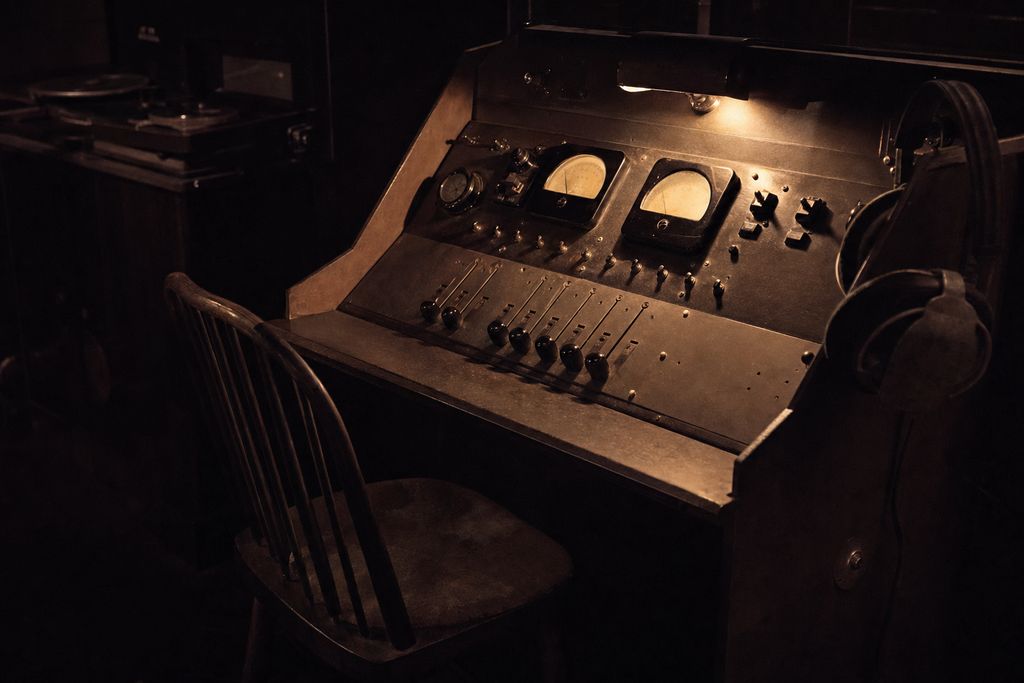
- Before broadcasting Salon orchestras, spas, piers and the cinema pit
- Carry On Henry Eric Rogers and the Carry On scores
- Working in light music Sessions, the union, and the needle-time agreements
Frequently asked questions
What was needle time?
A limit, agreed with the record industry and the musicians’ union, on how many hours of commercial records a broadcaster could play. Everything else had to be performed.
Why did a broadcaster employ its own orchestras?
Because the limit made it cheaper to pay musicians than to run out of programming. The orchestras were a consequence of an agreement, not of a taste for orchestras.
What happened to those orchestras?
They were disbanded as the limit was relaxed and the cost comparison reversed. The repertoire written for them stopped being written at the same time.
Why is regional television music so hard to attribute?
Because the smaller franchises kept no orchestra and little paperwork. A theme heard nightly across one region for twenty years can be one afternoon’s work under a single fee.
What is library music?
Music written to a brief and sold by the publisher to anybody who needs it. It solved the same problem as a commission at a fraction of the cost, and it carried no credit.
Was a composer paid twice for the same piece?
Not usually. Library work paid once and earned for the publisher afterwards. A broadcast performance generated a payment, but to whoever held the rights.
Why do signature tunes so often have no credit on air?
Because a signature tune was frequently a library cue, chosen by a producer from a catalogue. Nobody involved thought the composer’s name was information the audience needed.
What survives from these broadcasts?
Less than the paperwork suggests. Schedules, scripts and parts survive well; the sound of the performance mostly does not, because it was rarely recorded to keep.
- Sources
- Checked
- REF/HUB-BROADCASTING · 3 sources