Transfer and restoration
Sound restoration, and why this repertoire is audible at all
Almost everything written about British light music assumes the reader can hear it. That assumption rests on a small number of people transferring shellac discs one side at a time, and on the judgement of whoever decides a transfer is good enough to issue.
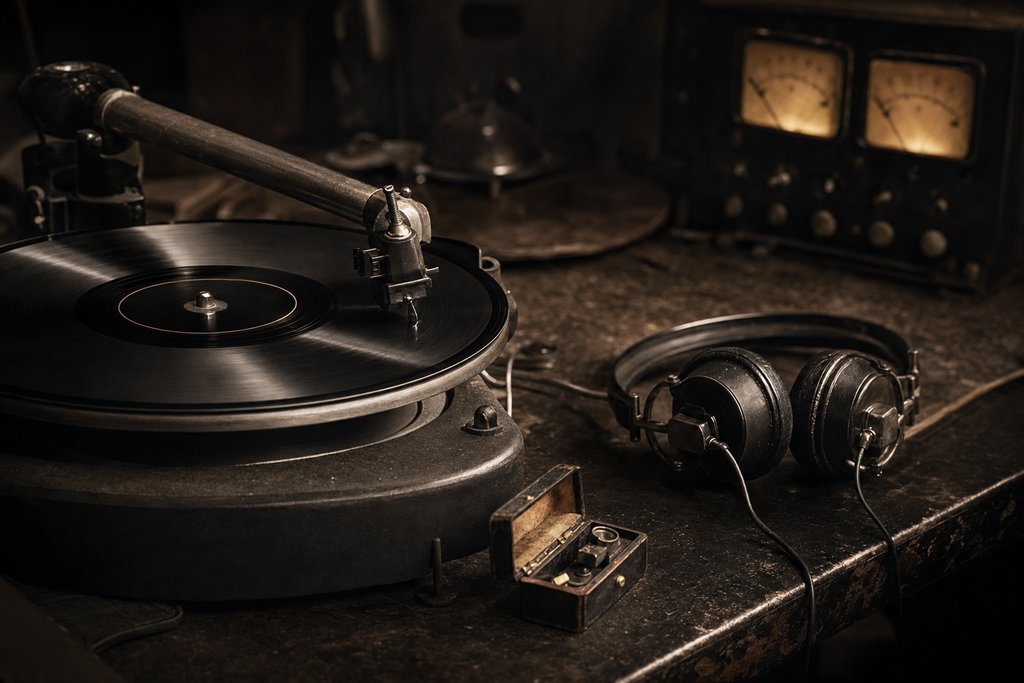
One side at a time
A shellac disc goes on a turntable. Somebody selects a stylus by measuring what the groove will take, chooses a playback curve appropriate to the company and the year, listens to three minutes of music, and then does it again with the next disc. That is the mechanism by which British light music reached the present, and it is worth stating plainly because every other page on this site quietly depends on it.
The dependency is not shared equally across musical repertoires. A Beethoven symphony recorded badly in 1930 is not a problem, because the work exists independently of any performance and better recordings arrived. A light orchestral piece recorded once, by a studio orchestra convened for the session, from parts that may no longer exist, has no independent existence to fall back on. The disc is not a document of the work. For practical purposes it is the work.
So the people who transfer these discs are not archivists serving the music. They are the reason there is anything to serve.
What a 78 will and will not give you
The format imposed itself on everything, starting with length.
A ten-inch side at roughly seventy-eight revolutions a minute holds around three minutes. That is the entire explanation for why this repertoire is full of three-minute pieces, and it is worth resisting the temptation to find an aesthetic reason for it. The composers wrote to the side. When the format changed the pieces got longer.
The frequency range is narrow at both ends and the surface generates noise regardless of condition, because shellac is a loaded compound with abrasive filler in it. Dynamic range is limited by how much groove modulation the wall will survive, which is why orchestral recordings of the period sit in a compressed band and why a loud tutti sounds constrained rather than loud.
None of that is damage. It is the medium working correctly, and a transfer that tries to correct it produces something that never existed.
The two decisions that cannot be undone
This is the technical section, and it stops the account because the following two choices are made before any restoration begins and cannot be revisited afterwards.
The first is the stylus. Groove dimensions were not standardised across companies or across the decades a label was in business, so a stylus correct for one pressing sits at the wrong depth in another, riding on the groove walls where the damage is instead of in the part carrying signal. Choosing well means measuring the specific disc rather than applying a rule, and a transfer made with the wrong stylus has captured wall damage as though it were music. No later processing separates them, because by then they are the same signal.
The second is the playback equalisation. Recordings were cut with a deliberate frequency shaping that playback was supposed to reverse, and the curve used differed between companies and changed over time, in a period before any of it was standardised. Applying the wrong curve produces a transfer that is dull or harsh across the whole side. It can be compensated afterwards and the compensation is never clean, because the error is frequency-dependent and interacts with everything the restoration does next.
Both decisions are made by a person listening, using documentation where it exists and judgement where it does not. This is why transfer work does not scale and has not been automated: the operations are mechanical and the decisions are not.
Where noise reduction stops being an improvement
Everything after the transfer is subtraction, and subtraction is where restoration goes wrong.
Clicks and thumps are discrete events, locatable and removable with little cost, and nobody argues about them. Broadband hiss is different in kind. Removing it means deciding, frequency band by frequency band and moment by moment, which energy is music and which is surface, and on a recording where the quiet string passages sit barely above the noise floor those two categories overlap. Take out the noise there and the music goes with it.
The result has a recognisable signature once you have heard it. The obvious noise is gone. So is the air around the orchestra, the decay of the hall, and the top of the string tone, and what is left sounds clean, flat and slightly synthetic, as though the players were in a smaller room than they were.
The working standard among people who do this well is therefore to stop early and accept audible surface noise as the price of keeping the sound of an orchestra. A restoration with no noise in it is not a triumph. It is usually a warning.
The series that carried the repertoire
British light music has no institutional archive programme. What it has instead is commercial reissue by specialists, and one series dominates.
Guild’s The Golden Age of Light Music began in 2004, compiled by David Ades, and ran past a hundred volumes: a systematic pass through the 78s, the light orchestral issues and the publisher library discs, sequenced into programmes and issued with booklets. The sound restoration was done by Alan Bunting. Whatever a general listener has heard of this repertoire, there is a strong likelihood it reached them through that series or one modelled on it.
Two things about how it was run are worth recording. The first is that Bunting has described monitoring on headphones and cross-checking on more than one loudspeaker system, which is ordinary good practice and worth naming because the alternative is judging a transfer on one set of speakers whose faults the restorer has stopped hearing.
The second is more interesting: he has described working with a right of veto. If a transfer could not be brought up to his own standard, the track was not issued. In a commercial reissue programme, where the compiler wants a full and coherent programme and the schedule wants a disc finished, a restorer able to refuse a track is an unusual arrangement and a good one. It means the series has a floor.
Pitch, speed, and the thing nobody notices
One correction happens before any of the audible work and it decides what key the music is in.
Seventy-eight revolutions a minute is a nominal figure. Recording lathes of the period ran at whatever their drive actually produced, and the tolerated spread was wide enough to move a recording by an appreciable fraction of a semitone. A side transferred at a plain 78 can therefore come out slightly sharp or slightly flat of the key the orchestra played in, and it will sound perfectly plausible, because nothing in the music announces that it is in the wrong place.
Establishing the right speed means finding a reference. Where the piece is known from printed music, the written key settles it. Where a tuning note or a recognisable instrument with a fixed pitch appears, that helps. Where neither exists, and for a great deal of library material neither does, the transfer is made at a defensible speed and the uncertainty stays in the result.
The consequence for anybody using these reissues as evidence is worth stating. A modern transfer is a reading of the disc rather than a neutral copy of it, and two competent restorers can produce two transfers of the same side that differ in pitch, in tone and in how much surface noise was left in. Neither is wrong. But a researcher comparing two issues of the same recording and finding them different is looking at two interpretations and not at a discrepancy to be resolved.
This is the ordinary condition of restored historical audio and it is almost never mentioned in the writing that depends on it.
The booklets are the documentation
A consequence of all this is easy to miss and matters to anybody researching the field.
Compiling a reissue disc requires establishing what the tracks are: the orchestra, the date, the matrix number, sometimes the composer where the label abbreviated or replaced the name. That work has to be done anyway, and the place it gets published is the booklet. Which means the booklet frequently contains the only printed recording date for a piece of music, the only personnel note, the only correction of a misattributed composer credit.
Nobody else had a reason to publish those facts. No academic journal covered this repertoire, no discographical institution indexed the library labels, and the record companies that made the discs disposed of their paperwork. A reissue booklet is therefore a primary source dressed as marketing, and this site cites them accordingly.
The corollary is uncomfortable. The documentation of British light music is distributed across some hundreds of CD booklets, most of them out of print, none of them indexed together, and there is no central record of what they collectively establish.
What restoration cannot fix
It cannot supply what was never recorded, and that is the larger loss.
Broadcasting produced far more of this music than commercial recording did, in hundreds of hours of live studio orchestral work that either was never captured or was captured on material that was reused, wiped or thrown out as a matter of routine policy. No transfer technique reaches it. The best restoration in the world applied to every surviving disc still leaves the recorded repertoire smaller than the performed repertoire by an amount nobody can estimate.
It also cannot fix attribution. A library disc with a house name on the label yields a clean transfer and a wrong composer credit, and separating the two requires publisher paperwork rather than audio work.
What restoration does is narrower and still decisive: it takes the material that does survive, in a format almost nobody can play, on discs held mostly in private hands, and makes it audible. Everything written about this repertoire in the last twenty years rests on that, and it was done by a handful of people one side at a time.
Frequently asked questions
Why does light music depend on restoration more than other repertoire?
Because it was issued on shellac and on publisher library discs and then almost none of it was reissued commercially for decades. Classical repertoire got re-recorded by later performers, so a modern listener does not need the 1935 disc. A light orchestral piece recorded once in 1935 by an orchestra that no longer exists has no modern performance to fall back on, so the disc is the work.
What is actually on a 78?
A mechanical groove cut into shellac, played back at roughly seventy-eight revolutions a minute, carrying a usable frequency range far narrower than a modern recording and a surface that generates noise of its own. Sides run to around three to four minutes, which is why the repertoire is full of three-minute pieces: the format set the length, not the composers.
What is the hardest part of the transfer?
Choosing the stylus and the equalisation, before any digital work begins. Groove dimensions varied between companies and periods, so a stylus that fits one label sits wrong in another and picks up wall damage instead of signal. Recording characteristics also varied, so the curve applied at playback has to match the one used at cutting, and getting that wrong produces a transfer that sounds dull or shrill and is not recoverable later.
Can restoration remove all the noise?
It can remove a great deal of it and the question is what goes with it. Broadband noise reduction works by deciding what is signal and what is not, and on a recording where the quiet passages are close to the noise floor those decisions remove music too. Over-processed transfers have a characteristic sound: clean, airless, with the string tone hollowed out and the reverberation gone.
So what does a good restoration sound like?
Like a slightly noisy recording of an orchestra rather than a quiet recording of something else. The judgement is a trade rather than a target, and the working standard among people who do it well is to stop while the music still has its air, accepting audible surface noise as the cost. A transfer with no noise at all is usually evidence of a problem.
Who did this work for British light music?
Specialist labels and individuals rather than institutions. Guild's The Golden Age of Light Music series, begun in 2004 and compiled by David Ades, ran to well over a hundred volumes, with sound restoration by Alan Bunting. That series is the single largest reason a general listener can hear this repertoire at all.
Does the restorer get to refuse a track?
On that series, yes, and it is a detail worth knowing because it is unusual. Bunting has described working to a self-imposed standard with a right of veto: if a transfer cannot be brought up to it, the track does not go on the disc. A compiler wanting a complete programme and a restorer able to say no is a healthier arrangement than the reverse.
Why are reissue booklets cited as sources on this site?
Because they frequently contain the only published recording dates, personnel notes and matrix details for the material on the disc. The compiler had the paperwork in front of them and no other publication had a reason to print it. For a lot of this repertoire the booklet is a primary source, and treating it as marketing copy loses the only documentation there is.
What is a library disc and why does it complicate things?
A recording made for a publisher's catalogue and licensed to productions rather than sold to the public. They were pressed in small numbers, distributed to producers, and never intended to survive, so surviving copies are frequently the only ones. Composer credits on them were abbreviated or replaced by house names, which is why a restoration project often ends up doing attribution work as well as audio work.
Is the original tape ever available instead?
Sometimes, for the post-war material, and it is not automatically better. Tape from the 1950s and 1960s suffers from binder deterioration and print-through, and where a master was reused or discarded the commercially issued disc is what remains. A published pressing in good condition can be a more reliable source than a degraded master.
What happens to this material if nobody transfers it?
It becomes inaccessible without ceasing to exist, which is the quiet form of loss. Shellac is chemically stable and physically fragile: a disc in a box is fine and a disc played on the wrong stylus is damaged permanently. The material is not disappearing so much as sitting in private collections in a format almost nobody can play.
Can a modern orchestra just record the music again?
For the concert pieces, yes, and it has been done. For the bulk of the catalogue the obstacles are practical: the performing material may not survive, the attribution may be uncertain, and the reason the original recording is interesting is often the orchestra and the arrangement rather than the notes. A new recording of a library track is a different object from the track.