Repertoire
1920s jazz standards, and how they reached British bandstands
A band in a British ballroom in 1930 was playing songs written in New York within the previous ten years, and a surprising number of them are still being played now.
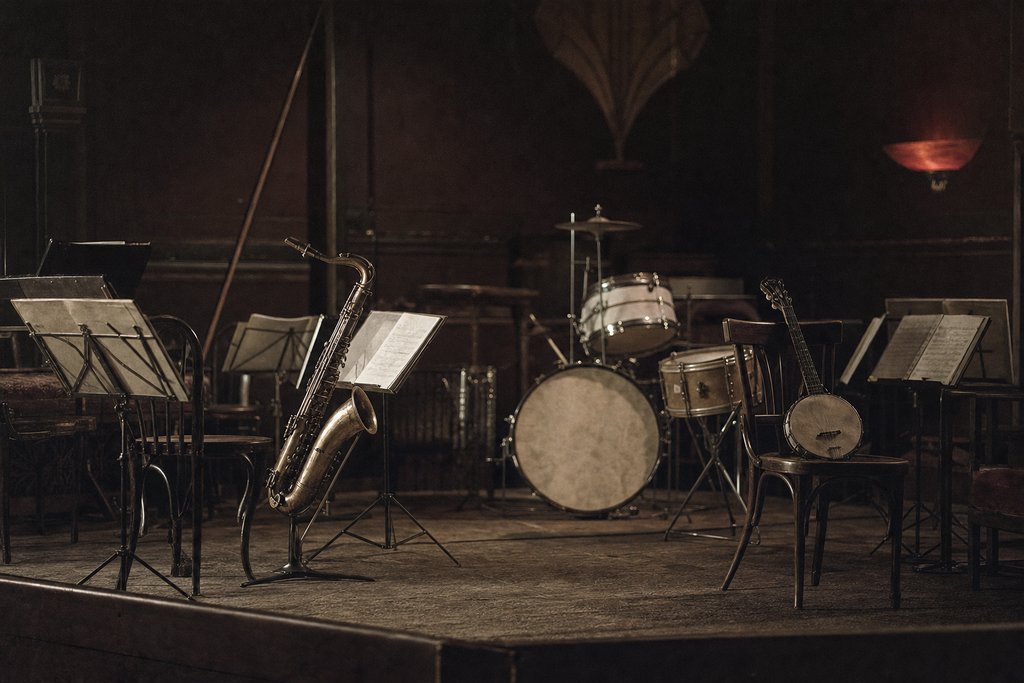
The repertoire a British band actually played
A dance band on a bandstand in Manchester or Glasgow in 1930 was, for most of the evening, playing American songs written within the previous decade. That is the fact this page exists to explain, and it is the connection between the 1920s jazz standards and everything else on this site.
The situation was not resented and was barely remarked on. American popular song had become the international product, British publishers held the local rights and promoted the same titles their New York counterparts were promoting, and the audience had heard the tunes on gramophone records before the band played them. A leader who filled an evening with British material would have been programming music his dancers did not know.
What British bands supplied was not the songs but the performance: the arrangement, the ensemble discipline, the tempo appropriate to the room and the dance. That division of labour, imported material and domestic craft, ran through British popular music for forty years.
What makes a standard
The term is used loosely, so it is worth being precise. A jazz standard is a song that has entered the permanent working repertoire and stayed there, played and recorded repeatedly by musicians across generations who did not learn it from its composer and often do not know who that was.
Nothing confers the status. It accumulates. A song is recorded, other musicians hear the record and learn the song, and if enough of them keep choosing it over the alternatives it becomes part of the common stock. The process is a selection by players rather than by the public, which is why commercial success in the year of publication predicts survival so poorly.
The 1920s matter because they are the first decade to produce a substantial layer of songs that made it through. Three things existed simultaneously for the first time: an industrialised song-publishing business, a recording industry with genuine reach, and a broadcasting audience. A song could therefore be heard across the English-speaking world within months of being written, which had not been possible before and made a common repertoire possible.
Why some songs lasted
The songs that survived did not survive because they were the best-loved at the time. Enormous numbers of successful 1920s songs are entirely gone.
What the survivors have in common is structural. A song that lasts in this repertoire tends to have harmonic movement that gives an improviser something to work with, a chord sequence that can be substituted and reharmonised without the tune becoming unrecognisable, and a shape regular enough to be learned quickly by musicians who have never played together. A melody that is merely charming, sitting on static harmony, gives a player nothing to do on the second chorus.
This is a selection pressure applied by working musicians for practical reasons, and it explains why the surviving repertoire looks arbitrary from outside. It is not a canon assembled by critics. It is the set of songs that turned out to be useful.
The shape of the songs
The 1920s produced not only a body of songs but a template, and the template is why the repertoire works as a common language.
A popular song of the period was published in two parts: a verse, which set up a situation, and a chorus, which carried the tune everybody remembered. Almost universally the chorus ran thirty-two bars, divided into four eight-bar sections in the pattern AABA, where the A sections state a phrase and the B section, the middle eight, departs from it before the last A returns. Within a few years of the form settling, working musicians had stopped playing the verse at all, and the thirty-two-bar chorus became the unit of performance: what a band played, what a soloist improvised on, and what a singer sang. That convention is the practical basis of the whole standards repertoire, because a musician who knows the form can play a song after hearing the chorus once, in any key, with strangers, without a part. It is also why a set of unrelated songs from different shows by different writers can function as a single shared vocabulary.
Two consequences follow for the British bands. Because the form was fixed, an arranger writing for a ballroom knew exactly how long a chorus lasted and could build a three-minute record as a sequence of choruses with a written introduction and coda, which is precisely how the records of the period are constructed. And because the verse was expendable, arrangers routinely discarded the part of the song that contained its narrative, which is one reason the surviving lyrics often make less sense in performance than on the page.
The form was not invented in the 1920s and did not end with it. What the decade did was standardise it across an entire industry, and it stayed standard for the next forty years.
Three channels into Britain
The transmission worked through three routes at once, and they operated at different speeds.
Publishing was the fastest and the most systematic. British editions of American songs appeared almost immediately, because the publishers were in commercial partnership and the sheet music was the primary product. A bandleader could buy the piano copy of a New York hit within weeks.
Records were slower but more useful, because a printed copy gives the notes and a record gives the performance. British dance-band musicians of the period studied American discs seriously, and the better players collected them privately. A published song tells you what to play; a record tells you how, and in this music the how is most of it.
Touring was the least frequent and the most influential. When American bands and soloists appeared in Britain, local musicians heard phrasing, articulation and rhythmic placement that no record of the period reproduced accurately, and the effect on individual players was disproportionate to the number of performances.
What British bands did differently
The difference was recognised at the time and the descriptions on both sides were consistent.
British dance bands were more precise. The ensemble was tighter, the reading was better, the intonation was more careful, and the arrangements were executed exactly as written. This was a rational response to the working conditions: a band playing for ballroom dancers to fixed tempi and broadcasting live to a national audience has strong reasons to be accurate and weak reasons to be loose.
What they had less of was rhythmic freedom. American musicians who heard British bands tended to praise the discipline and find the playing stiff, and British musicians who heard American bands tended to admire exactly what their own training had suppressed. Both assessments were accurate, and the gap narrowed through the 1930s as recordings circulated more widely.
The point is not that one was better. The two traditions were solving different problems for different employers.
Into the light orchestras and the libraries
This repertoire did not stay in the dance bands, and the crossover is the reason the subject belongs on this site at all.
The same songs were arranged for light orchestras, by the same arrangers, and recorded in the same studios by substantially the same session musicians. When a publisher’s recording library needed three minutes of something bright and modern, an arranger reached for this material, so 1920s standards ended up in the library catalogues described under British light music, sitting alongside original light-music compositions and available to the same film and radio producers.
That circulation had a lasting consequence. A great deal of what a British listener heard as background music through the 1940s and 1950s, in newsreels and documentaries and radio links, was 1920s American popular song arranged for a British light orchestra and licensed by the bar. The songs had become infrastructure.
The list nobody can settle
A caution, and it applies to every published list of standards including the ones cited on this page.
No authority maintains a definitive list, and the term has no agreed definition. Compilers disagree about the basic tests: whether a song needs recordings spread over three or four decades or merely a large number of them, whether adoption by jazz musicians specifically is required or whether the singers’ repertoire counts, how to handle songs that are standards in one country and unknown in another, and what to do with titles that were revived after fifty years of neglect.
These are not disagreements that better research would resolve. They are consequences of applying a category with soft edges to a body of material that runs into thousands of titles. Any list, including a good one, is a defensible judgement rather than a finding, and two careful compilers will produce lists that differ by a third.
If you are using a list of 1920s standards for research, the useful question is not whether it is correct but what test its compiler applied, and that is usually stated somewhere in the front matter.
Frequently asked questions
What is a jazz standard?
A song that has entered the permanent working repertoire, played and recorded repeatedly across generations by musicians who did not learn it from the composer. Nobody declares a song a standard; it becomes one by being chosen often enough over long enough. The 1920s jazz standards are the earliest large group of songs to achieve that status and still hold it.
Which decade produced the most standards?
The 1920s and 1930s between them produced the core of the repertoire, with the 1920s supplying the earliest layer that is still in general use. What makes the decade distinctive is that it is the first in which the commercial song industry, the recording industry and a broadcasting audience all existed at once, so a song could reach the whole English-speaking world within months.
Why did British bands play American songs?
Because that is what the audience wanted and what the publishers were selling. American popular song dominated the sheet-music and record markets, British publishers held the local rights and pushed the same titles, and dancers had heard the tunes on record. A British band playing its own country's material exclusively would have been playing to an audience that had not heard any of it.
How did the songs reach Britain?
Through three channels running at once. Publishers issued British editions of American songs almost immediately. Records arrived commercially and through musicians who bought them privately, and a good dance-band player of the period studied American discs closely. And American bands and soloists toured, which mattered disproportionately because it let British musicians hear the phrasing rather than only the notes.
Did British bands play them the same way?
No, and the difference was noted at the time on both sides. British dance bands were more precise, better drilled and less rhythmically loose than their American counterparts, which suited a ballroom floor and a broadcasting schedule. American musicians who heard British bands frequently praised the ensemble and criticised the swing, and both judgements were fair.
What is the connection to British light music?
Direct and often overlooked. The same songs were arranged for light orchestras as well as dance bands, and the same session players recorded both. When a publisher's recording library wanted three minutes of something bright, an arranger reached for this repertoire, so the 1920s jazz standards ended up circulating through the library catalogues alongside original light-music pieces.
Are these songs still played?
Continuously, in three separate worlds that rarely acknowledge each other: by jazz musicians as improvising vehicles, by singers as concert and cabaret repertoire, and by dance orchestras for ballroom dancing to prescribed tempi. The same song can be a harmonic framework, a lyric performance or a strict-tempo foxtrot depending on which of those rooms it is played in.
Who wrote them?
Mostly professional songwriters working for New York publishers, frequently in composer-and-lyricist teams, and a substantial share of the durable titles came from stage shows rather than from Tin Pan Alley alone. The writers were producing to commercial deadlines for immediate sale, with no expectation that anything would last a century, which is worth remembering when the results are discussed as a canon.
Why do the same few songs keep recurring?
Because a standard survives on its structure, not its melody. Songs that lasted tend to have harmonic movement that rewards improvisation and a shape that can be reharmonised without collapsing. Thousands of songs from the decade sold well and vanished. The ones that stayed are the ones a musician can do something with, which is a selection made by players rather than by the public.
Is the list of standards settled?
No. There is no authority that maintains one, and every published list is somebody's judgement applied to a body of material with fuzzy edges. Compilers disagree about whether a song needs recordings spanning three or four decades, whether jazz musicians specifically must have adopted it, and how to treat titles that are standards for singers but not for instrumentalists. The disagreements are not resolvable because the term has no definition.
- Sources
- Checked
- REF/JS-1920 · 4 sources