Film music
Carry On Henry, and how Eric Rogers scored the Carry On films
Eric Rogers wrote the music for more than twenty Carry On films, and the scores are a working demonstration of what a light-music arranger could do when the brief was comedy.
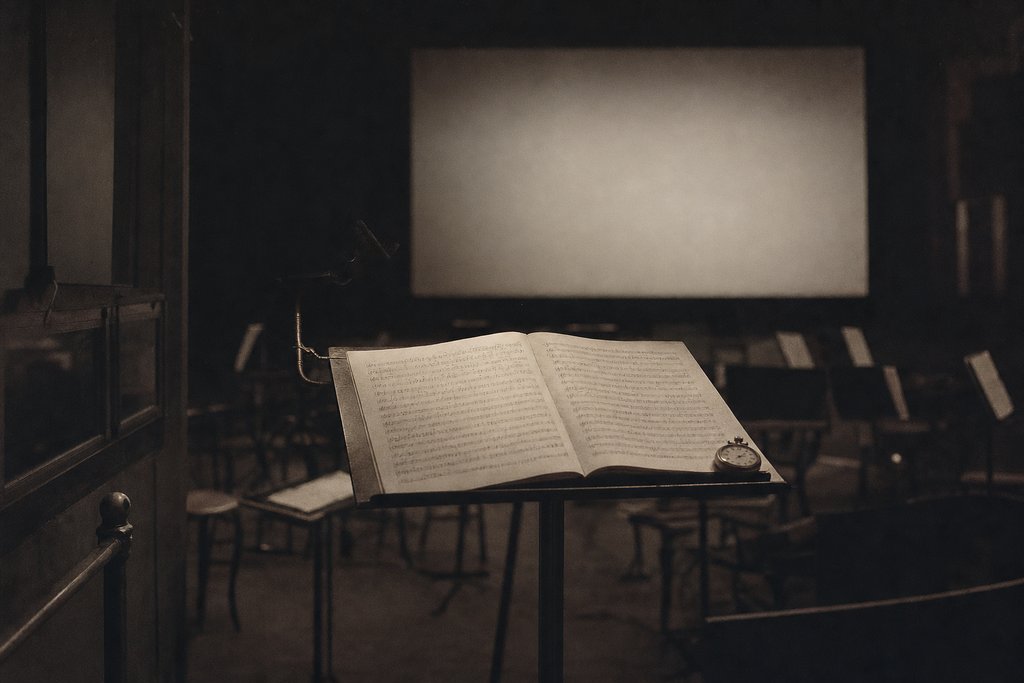
An arranger at a scoring session
Eric Rogers spent his working life in front of London session orchestras, writing music against a clock for somebody else’s product. The Carry On films are the part of that career with his name on screen, and they are also the part that is least like concert composition and most like the library work described under British light music.
He came from the same professional world as almost everybody on this site. He was an arranger and conductor rather than a composer in the concert sense, he worked commercially from the 1950s, and his skills were the practical ones: writing to an exact duration, scoring for whatever forces the budget allowed, and getting it right at the first session because there would not be a second.
His most substantial single credit outside the films demonstrates the point better than any of them. When Lionel Bart wrote Oliver!, he produced tunes and lyrics but could not write music down, so somebody had to take the songs from him and turn them into an orchestral score. That was Rogers. The material is Bart’s and the sound of the show is not, which is the cleanest available illustration of what an arranger’s contribution consists of.
Twenty years of a series
From Carry On Cabby in 1963 onwards, Rogers scored the great majority of the Carry On films, which by the end of the run amounted to more than twenty pictures across roughly two decades.
The production conditions were the significant fact. These were low-budget comedies made quickly on a fixed pattern, and the music was one of the last elements added, to a locked cut, with a session orchestra booked for a short call. The composer received the picture with timings, wrote to them, and recorded. There was no development period and no possibility of a re-score.
A body of twenty scores produced under those conditions is not a series of individual artistic statements. It is a working method applied repeatedly, and it should be assessed as such. What is impressive about it is the consistency: the timing is reliably exact, the pastiche reliably legible, and the orchestration reliably efficient for the number of players paid for.
What the score is for
Comedy scoring is functional, and it is worth being specific about the functions, because the writing follows from them.
The first job is marking the gags. A physical joke, a fall, a collision, a door in the face, needs musical punctuation, because the audience takes its cue about whether something was intentional partly from the soundtrack. The technique is old, borrowed from silent comedy and from animation, and it demands timing accurate to the frame.
The second is establishing the setting, almost always through pastiche. A film opening on a Tudor court needs the audience oriented within about ten seconds, and music does that faster than dialogue or set dressing.
The third is covering ground. A comedy has dead intervals between jokes, and the score carries the audience across them without letting attention drop. This is the least noticed and most skilled part of the work, because doing it badly is obvious and doing it well is invisible.
Tudor pastiche, and a useful myth
Carry On Henry is set at the court of Henry VIII, which hands the composer a well-stocked toolbox and one very convenient piece of popular misinformation.
The toolbox is the set of gestures a modern audience reads as early music: modal melody rather than functional major and minor, open consort-like textures, a plucked instrument standing in for a lute, and a drum pattern implying a tabor. None of this is historically accurate scoring, and it is not meant to be. The object is recognition, and recognition depends on the audience’s existing associations rather than on the sixteenth century.
The convenient misinformation is Greensleeves. The tune is popularly attributed to Henry VIII, an attribution musicologists reject: the style and the earliest documented appearances both point to a date after his reign. For a comedy score this is not a problem but an asset. The association is universal among British audiences, it identifies the period and the king in a couple of bars, and the fact that it is almost certainly wrong costs the film nothing, because the joke depends on what the audience believes rather than on what happened.
That is a good general lesson about pastiche scoring. It works on received ideas about a period, and received ideas are frequently false. The composer’s job is to reach for whatever the audience already carries, correct or not, because a cue has seconds to establish a setting and no time to teach anybody anything. Accuracy would often be counterproductive: a genuine sixteenth-century consort piece, played straight, would not read as Tudor to a modern audience nearly as quickly as the pastiche does.
An orchestra is cheap production value
There is an economic argument for music in a film like this, and it is the reason the series could afford a composer at all when it could not afford much else.
A Carry On picture was made on a small budget with modest sets, a fixed company of actors and short schedules. The visible production value was limited by what a set costs. Music is the exception: a thirty-piece orchestra for a three-hour session is a small line in a film budget, and it puts a sound on the screen that a viewer reads as a larger production. Scoring is the cheapest available way of making a cheap film feel less cheap, which is why low-budget cinema has historically spent a larger share of its budget on music than expensive cinema does.
That calculation shaped the writing. The brief was not to be interesting but to be full: to produce a sound with enough body to carry the picture, from an ensemble small enough to be affordable, without any passage that would need extra rehearsal. Eric Rogers was hired repeatedly over two decades because he delivered exactly that, and a composer with grander intentions would have been a liability.
A series with a musical brand
Twenty scores across twenty years also produce something the individual films did not set out to create, which is a recognisable musical manner attached to a franchise.
The Carry On films acquired one. A viewer hearing a few bars of the title music of any entry in the series can place it immediately, not because the themes recur but because the treatment does: the instrumental character, the rhythmic bounce, the type of gesture used to mark a joke. Over twenty pictures a method becomes an identity.
The trade-off is inflexibility. Once an audience expects a particular musical manner from a series, a composer who departs from it is fighting the expectation rather than the material, and the later films in a long-running series are usually the ones where that constraint is most visible. A scoring approach that was a fresh solution in 1963 is a house style by 1971 and a limitation by the end.
This is the same mechanism, working over a franchise rather than a fleet, that makes recognisable house styles a mixed asset for any producer of serial work. It is useful until the point where it stops being a choice.
The same people, the same rooms
The connection to the rest of this site is not thematic but literal.
Rogers recorded with London session musicians, in London studios, using the same fixers and frequently the same players who appeared on the library discs and the light orchestral recordings. The disciplines are identical: a two-minute film cue and a two-minute library cue are the same technical problem, and composers moved between the two without adjustment.
The economics were also similar, with one important difference. Library music paid on licensing, so a successful piece earned indefinitely from producers who never learned the composer’s name. Film work paid a fee for the picture. A film composer therefore had his name on screen and less of a long tail, which is close to the inverse of the library composer’s position described under Charles Williams.
What is not recorded
This page has to end on an absence, because the documentation for this material is worse than for almost anything else on the site.
Cue sheets, session dates, orchestra sizes and personnel for the Carry On films were production paperwork. They were not published, not deposited, and not of interest to anybody at the time, because these were cheap comedies with no expectation of later attention. What survives is largely screen credits, which name the composer and nothing else.
Rogers’s work outside the films is in a worse state again. He was a jobbing arranger and conductor with output scattered across commercial sessions, stage productions and light orchestral recording, credited inconsistently and never catalogued. The Carry On credits are visible precisely because a film has titles and a library disc does not, which means the accessible record of his career is skewed towards the part of it that mattered least to him professionally.
If you are trying to establish what Eric Rogers actually wrote, treat the film list as a floor rather than a summary. The music that is easiest to find is not the music he spent most of his time making.
Frequently asked questions
Who wrote the music for Carry On Henry?
Eric Rogers, who scored the great majority of the Carry On films from Carry On Cabby in 1963 onwards. Carry On Henry was released in 1971 and is one of the Tudor-costume entries in the series, which gave him a period idiom to work against. Rogers was a working light-music arranger and conductor before and alongside the film work.
Who was Eric Rogers?
An English composer, arranger and conductor, active from the 1950s until his death in 1981. He came from the same professional world as the other figures on this site: commercial arranging, session conducting and light orchestral work. His most substantial credit outside the Carry On films is the orchestration of Lionel Bart's stage musical Oliver!, and that is the work of a first-rate technician.
Did Eric Rogers orchestrate Oliver!?
He did the orchestration for the stage production. Lionel Bart wrote tunes and lyrics but could not notate music, so the songs had to be taken down and scored by somebody else, and the orchestral realisation of that show is Rogers's work. It is the clearest illustration of what an arranger contributes: the material is Bart's and the sound of it is not.
What does a comedy film score actually do?
Three jobs, and they are technical rather than expressive. It marks the physical gags, so a fall or a collision gets a musical punctuation that tells the audience it was meant to be funny. It sets the period or place, usually by pastiche. And it carries the audience over cuts and dead ground between jokes. None of this requires original melody, and all of it requires exact timing.
What is pastiche scoring?
Writing in a recognisable historical or national style in order to signal a setting. For a Tudor film that means the gestures an audience reads as early music: modal melody, consort textures, a drum pattern suggesting a tabor, a plucked instrument standing in for a lute. It does not need to be historically accurate and generally is not, because the object is instant recognition rather than reconstruction.
Does the score quote Greensleeves?
Tudor-set comedies of this kind lean heavily on it, and the reason is a myth the audience already holds: Greensleeves is popularly attributed to Henry VIII, an attribution that musicologists reject on stylistic and dating grounds. A comedy score can rely on the association working instantly whether or not it is true, and the fact that the tune almost certainly postdates Henry does not weaken the joke at all.
How does this connect to British light music?
Directly, through personnel and method. Eric Rogers was a light-music arranger doing film work, using the same London session musicians and the same studios as the library and orchestral recordings covered elsewhere on this site. Composing to picture and composing to a library brief are the same discipline: correctly timed, immediately playable orchestral music produced to order.
Are the Carry On scores any good?
Technically, yes, and consistently. The timing is exact, the pastiche is accurate enough to land in a few seconds, the orchestration is efficient for the forces available, and the scores do their work without drawing attention. Judged as concert music they are nothing. Judged as what they are, which is functional writing produced at speed to a fixed budget, they are the work of somebody who was very good at it.
Were the scores released on record?
Barely at the time. Comedy film scores were not a commercial album proposition in the 1960s and 1970s, and the music existed as recordings made for the picture rather than for sale. Compilations have appeared since, assembled from film soundtracks, but there is nothing comparable to the systematic reissue programmes that recovered the light orchestral and library repertoire.
Is the music documented?
Poorly. Cue sheets, session dates and orchestra personnel for these films were production paperwork rather than published information, and the series was made cheaply on tight schedules with no expectation of later interest. What is known about Eric Rogers's contribution comes mostly from screen credits and from recollection, and his non-film arranging is scattered across catalogues that were never assembled.
- Sources
- Checked
- REF/CO-H71 · 5 sources