Origins
Light music before broadcasting: salon, spa and pier
For about forty years before broadcasting existed, anybody in Britain who wanted to hear an orchestra had to be in a room with one, and that single fact supported an entire profession.
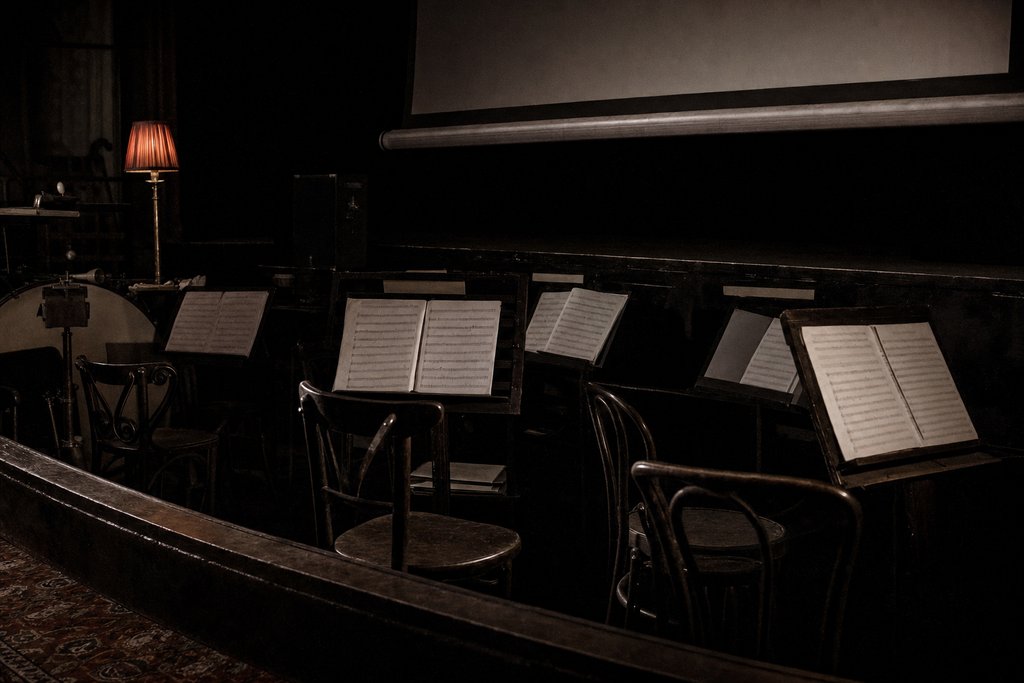
A room with an orchestra in it
Before 1920 there was one way to hear an orchestra, and it was to be in the same room as one. That sentence is easy to read past and it is the whole economic basis of the world this page describes.
No gramophone in a domestic setting could reproduce an orchestra convincingly. There was no broadcasting. If a hotel wanted music in its lounge, a restaurant wanted music with dinner, a resort wanted music in its gardens or a cinema wanted music under its films, each of them had to hire and pay musicians, on the premises, for every hour the music was wanted. Multiply that across every hotel of standing, every spa town, every pier, every large restaurant and every picture house in Britain and the scale of employment becomes clear.
This was the profession that British light music grew out of. Not a concert tradition and not a compositional school, but a service industry with a very large payroll.
The salon orchestra
The characteristic ensemble was small. A salon orchestra might be five or six players, built around piano, violin and cello with whatever else the budget allowed, and it played in hotels, restaurants, tea rooms and department stores.
Its repertoire was light classics, opera excerpts arranged down, waltzes, marches and popular songs of the day, and almost all of it arrived as published arrangements written specifically for these forces. This is where the arranging trade begins. Publishers issued the standard repertoire in versions scored for small ensembles with optional parts, so that a group of six could play a piece written for a full orchestra by covering the essential lines and omitting the rest, and a group of twelve could play the same publication more fully. The arranger’s skill was making a reduction that still sounded complete.
That skill is the direct ancestor of everything described under British light music. The publishers who supplied salon arrangements are in more than one case the same firms that later ran the recorded music libraries, doing the same thing for a different delivery mechanism.
Palm courts, spas and piers
Three settings deserve naming because their names outlived them.
The palm court was the lounge or winter garden of a large hotel, decorated with potted palms, with an ensemble playing to guests taking tea. The term has survived as a description of a manner rather than a place: gentle, string-led, unobtrusive music intended to be present without demanding attention.
Spa and resort towns employed orchestras because music was part of what they were selling. A visitor paying for a stay expected a band in the pump room or the gardens, and municipal corporations funded these ensembles directly as a tourist investment. Local government was therefore a significant employer of professional orchestral musicians in Britain before the First World War, which is not how local government is usually described.
Seaside piers had pavilions with resident ensembles playing daily through the season. The work was seasonal, the audience changed every day, and the repertoire had to satisfy people who had nothing in common except having paid to walk onto a pier. It required breadth rather than depth and enormous stamina.
The bandstand tradition alongside
Running parallel to all this was the brass and military band world, playing in municipal parks and on public bandstands, and the relationship needs stating carefully because the two are often conflated.
The bands shared a good deal of repertoire with the salon ensembles, in arrangement, and they played in the same public spaces to overlapping audiences. But they were largely amateur, built around works, collieries, chapels and communities, with their own competitive circuit and their own institutions. The salon and resort ensembles were professional employment.
The two traditions therefore had different economics and different fates. When the professional market collapsed the players had to find other paid work. The band movement, resting on voluntary participation rather than on wages, was less exposed and survives today in a way the palm court does not.
What the players could do
It is worth being specific about the competence this world required, because it explains what the industry inherited.
A musician in a resort orchestra or a cinema pit read fluently, transposed on sight, played more than one instrument, and knew a repertoire of hundreds of pieces well enough to play them with minimal notice. A cinema player accompanied films the ensemble had frequently not seen, following the action in real time from a library of mood pieces. A pier musician played three or four programmes a day, six or seven days a week, through a season.
None of that is glamorous and all of it is difficult. When broadcasting and recording arrived, they arrived to a country full of musicians who could sight-read anything put in front of them and get it right first time, which is exactly what a live broadcast and a three-hour recording session require. The technical standard of British light music in the 1930s and 1940s rests on a labour force trained by the world that the new technologies destroyed.
The cinema pit, and where library music comes from
The largest single employer in this world was the cinema, and it deserves its own account because its working method is the direct ancestor of everything that came after.
A picture house before 1929 needed music continuously, because a silent film without it is unwatchable. The forces varied enormously with the size of the house: a small suburban cinema might have a pianist alone, a large city picture palace an orchestra of thirty or more with an organ as well. The music ran for the whole programme, and it had to fit the action.
The problem this created was practical rather than artistic. An orchestra could not rehearse a new score for every film in a programme that changed twice a week, and most films arrived with no score at all. The solution was a system that anybody who has read the rest of this site will recognise immediately. Publishers issued collections of short pieces indexed by dramatic situation: agitato for a chase, misterioso for a night scene, pastorale for open country, plus funeral marches, storms, hurries and love themes, each in a form that could be repeated, cut or extended at will. The musical director assembled a programme from that stock against a cue sheet, and the players read it.
That is a recorded music library, minus the recording. The indexing by mood and duration, the pieces built to be cut anywhere, the composer’s name irrelevant to the customer, the publisher as the brand: all of it existed in print for silent film before it existed on disc for sound film and radio. When the libraries described under British light music began issuing recordings in the 1930s, they were transferring an established business to a new medium, using the same publishers and frequently the same composers.
If you are looking for the origin of British light music as a trade rather than as a style, this is it. Not the concert hall and not the salon, but a system for supplying appropriate music to order, in quantity, indexed for retrieval. The technology changed three times. The business did not.
Three technologies, one collapse
The end came quickly and in sequence.
The gramophone made recorded music available in the home, which reduced the domestic demand that supported sheet music and amateur performance. Broadcasting from the 1920s made music available continuously and free, which undercut the commercial case for hiring players to fill a room. And synchronised sound film, arriving in Britain around 1929, eliminated the cinema orchestras almost immediately, because a soundtrack came with the print.
The cinema collapse is the sharpest example: a profession of thousands, employed continuously, made redundant inside about two years by a single technical change. The players dispersed into dance bands, broadcasting studios, recording sessions and teaching, and a substantial number left music altogether.
An archive of paper
This period is documented worse than the era that followed it, and the reason is simple: it produced almost no recordings.
What survives is printed matter. Published arrangements, in enormous quantity, held in libraries and in private collections. Municipal minutes and accounts recording the engagement and payment of orchestras, which are often the best evidence of what was played and by whom. Hotel and pier programmes. Local newspaper notices and reviews. Union records where they exist.
The consequence is that the sound of this world is essentially lost. What a spa orchestra in 1910 played is documented in considerable detail, because the programmes and the parts survive. What it sounded like is almost entirely unknown, because nobody recorded it and the performance conventions were not written down. Reconstructions exist and are informed guesses.
That gap is worth holding in mind when this repertoire is described as sentimental or genteel. Those judgements are made about printed music and about the settings it was played in, not about performances anybody has heard.
Frequently asked questions
What was a salon orchestra?
A small ensemble, often as few as five or six players built around piano, violin and cello, employed to play in hotels, restaurants, tea rooms and department stores. The repertoire was light classics, opera excerpts, waltzes and popular songs, all in published arrangements written specifically for these forces. It was the standard commercial music ensemble of the period before recording.
What was a palm court orchestra?
The same kind of ensemble in a particular setting: the lounge or winter garden of a large hotel, named for the potted palms that decorated such rooms. The term survives as a description of a repertoire and a manner, gentle, string-led and unobtrusive, long after the rooms themselves stopped employing musicians.
Why did spa towns have orchestras?
Because music was part of the product. A spa or resort town sold a stay, and the amenities that justified the price included a band in the pump room or the gardens. Municipal corporations funded these ensembles directly as a tourist investment, which made local government one of the significant employers of British orchestral musicians before the First World War.
Did piers have orchestras?
Seaside piers commonly had pavilions with resident ensembles, playing daily through the season to holidaymakers who had paid to come onto the pier. The engagements were seasonal, the audiences were transient, and the repertoire had to be broad enough to please people with no shared taste. It was demanding work and it kept a large body of players in employment.
What did these ensembles play?
Arrangements, overwhelmingly. Publishers issued the standard repertoire in versions scored for small forces with optional parts, so an ensemble of six could play something written for eighty by leaving out what it did not have and covering the important lines. That arranging trade is the direct ancestor of the light music publishing described under British light music.
How much employment did this create?
A very large number by any later standard, though precise figures are hard to establish. Every hotel of standing, every resort town, every pier pavilion, every large restaurant and every cinema employed players, and they employed them continuously rather than for occasional concerts. Live performance was the only delivery mechanism music had.
What ended it?
Three technologies in quick succession. The gramophone made recorded music available domestically, broadcasting made it available free, and the arrival of synchronised sound film in 1929 eliminated the cinema orchestras in a matter of months. The collapse was fast, and it happened to a profession with no other market to move into.
Is there a connection to brass bands?
A parallel rather than a direct one. The municipal and works brass band tradition ran alongside this world, played in the same public parks and bandstands, and shared a good deal of repertoire in arrangement. The bands were largely amateur and community-based, however, where the salon and resort ensembles were professional employment, and the two traditions kept separate institutions.
Did this repertoire survive?
Partly, by moving. The players who lost their jobs went into dance bands, broadcasting and recording, taking their skills and much of their repertoire with them, and the publishers redirected their arranging business towards the new markets. The salon orchestra itself did not survive, but the trade of writing playable arrangements for whatever forces were available did.
How well documented is this period?
Unevenly, and worse than the recorded era that followed. There are no recordings of most of these ensembles, because they existed before or outside the record industry. What survives is printed arrangements, municipal minutes and accounts, hotel and pier programmes, and local press. It is a paper archive rather than an audible one, and it is scattered across local record offices.
- Sources
- Checked
- REF/LM-ORIG · 5 sources