Producer, bandleader and arranger
Norrie Paramor, from light orchestral records to pop hits
15 May 1914 – 9 September 1979
Norrie Paramor ran a light orchestra and produced the most commercially successful British pop records of the late 1950s and 1960s, and he did both at the same time from the same desk.
A pianist in the dance-band trade
Norrie Paramor began where practically everybody on this site began, playing. Born in London on 15 May 1914, he worked as a pianist and arranger in the British dance-band business of the 1930s, including a period with Maurice Winnick’s orchestra, and served during the war in the entertainment organisation that absorbed a large part of the profession.
By the end of the 1940s he had the standard equipment of a working British light musician: he could play, arrange, conduct, and read a room. What he did with it was unusual. Instead of building a career as a bandleader, which was the obvious next step and the one most of his contemporaries took, he moved into the record industry on the other side of the glass.
Two jobs at one desk
From the 1950s Paramor worked for EMI’s Columbia label as a producer and artists-and-repertoire man, and he ran his own light orchestra as a recording artist on the same label at the same time.
The double role is worth pausing on because it would be unusual now and was not then. As an A and R man he decided which artists were signed, chose their material, commissioned or wrote the arrangements and supervised the sessions. As a recording artist he made light orchestral and mood albums under his own name, and some of them sold well. He was therefore one of the people deciding what the label released and one of the acts it released, and nobody appears to have thought this needed defending.
What it produced was a producer with a specific set of instincts. Somebody who has spent years writing charts for an orchestra hears a pop record as an arrangement problem: what plays the introduction, where the strings enter, how the ending works, how long it runs. That is exactly how his productions sound.
How a record was actually made
The A and R job is easier to assert than to picture, so it is worth setting out the sequence, because it explains where a producer’s judgement actually entered.
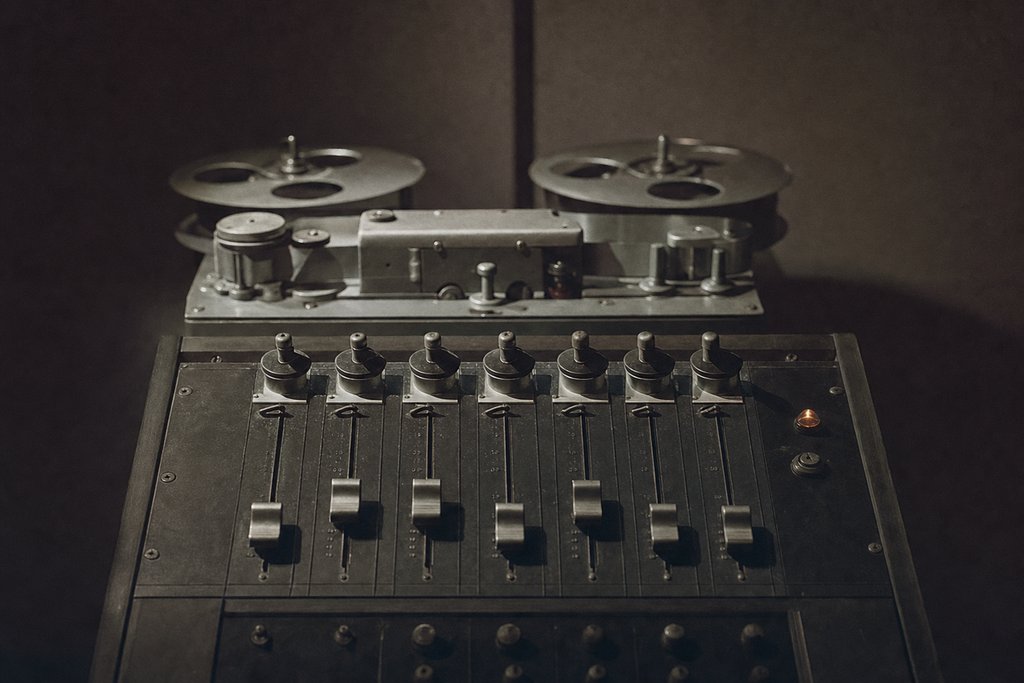
Material came to a producer before anything else did. Music publishers employed song-pluggers whose entire function was to get songs in front of the people who chose what artists recorded, and a producer at a major label received a continuous flow of them, on demonstration discs or played at the piano in his office. Choosing among that flow was the decision that mattered most, because a great performance of a weak song does not sell and an adequate performance of a strong one frequently does. Having chosen, the producer settled the key and the treatment, briefed or wrote the arrangement, booked the studio and the players through a fixer, and ran a session that was almost always three hours long and expected to produce two or three finished sides. Everything about that timetable rewarded preparation and punished experiment: an arrangement that did not work on the first run-through was costing money that could not be recovered, and there was no possibility of coming back next week to try again.
Two features of the results follow directly from the process. The records are tightly arranged, because the arrangement was written before anybody arrived and the session had no time to develop one. And they are short and clean, because a single had to fit a side, get through on radio and survive being played on a small record player.
Norrie Paramor was good at the first part of that chain, the choosing, and it is the part that leaves no trace. A producer’s successful judgements are visible as hit records credited to the artist, and his unsuccessful ones are invisible entirely. The only durable evidence of an A and R man’s ability is a strike rate, and his was high for about a decade.
The pop records
Paramor produced Cliff Richard and the Shadows through the period when they were the most commercially successful act in Britain, and the run of hits he supervised is one of the longest any British artist sustained before the mid-1960s. He worked with other successful singers on the same roster, and for roughly a decade he was among the most reliable hit-makers in the country.
His method was the light-music method applied to a new market. The records are carefully arranged rather than captured, the orchestration is deliberate, the balance is clean, and nothing is left to accident. Where an American rock and roll record of the same period might depend on the sound of a room and a band playing hard, a Paramor production depends on a written chart being executed accurately.
This produced the standing criticism of him, made at the time and repeated since: that he was too polished, that he smoothed the edges off the material, and that British pop of this period sounds tamer than its American equivalent partly because of decisions made by men like him. The criticism is fair as a description and unfair as a complaint, because the polish was the job. He was employed to make records that sold to a British audience through British radio, and they did.
Why the two halves belong together
The temptation is to treat the light orchestral work as the day job and the pop production as the real career, or the reverse. Neither is right, and the reason matters for how this whole repertoire is understood.
British light music and British pop production of the late 1950s were not separate industries. They used the same studios, the same session musicians, the same engineers, the same arrangers and the same labels. A string section that played on a light orchestral album in the morning played on a pop single in the afternoon, with the same players in the same chairs. The distinction between the two was a distinction of market, not of production.
Paramor is the clearest single demonstration of that, because the two functions were combined in one person. It also explains a feature of British pop records of the period that puzzles listeners approaching them from American rock and roll: the orchestral competence. Those records are arranged by people who wrote for orchestras professionally, because those were the people the labels employed.
The regional orchestra years
In the 1970s Paramor became musical director of the BBC Midland Radio Orchestra, one of the corporation’s regional house ensembles.
The move looks like a retreat and was probably something else. By the 1970s the BBC’s standing orchestras were among the last places in Britain where this repertoire was played regularly by a professional band on a salary, and directing one was a serious musical appointment rather than a sinecure. The commercial pop world he had dominated had also changed beyond recognition, in ways that had little use for a producer trained in the 1930s dance-band trade.
There is a further reason the appointment made sense. A regional radio orchestra existed to supply programmes with live music, which meant a weekly requirement for arrangements of whatever the schedule called for, produced fast and playable at one rehearsal. That is precisely the skill Paramor had been using since the 1930s, and it had become scarce: the generation trained to do it was retiring and the institutions that trained them had closed. A producer whose commercial instincts had been formed in a vanished market was, in this one respect, still exactly the right man for the job.
He died on 9 September 1979, aged sixty-five.
The catalogue that did not survive
Here is the imbalance this page has to end on, and it is not a small one.
The records Norrie Paramor produced for other artists are in permanent circulation. They have been reissued continuously for sixty years, they are on every retrospective compilation of British pop, and they are easy to hear in good transfers. The records he made under his own name have had nothing like that treatment. A substantial catalogue of light orchestral albums is out of print, available in part through compilations assembled without much care, and in some cases not transferred at all.
The reason is commercial rather than musical: pop catalogue has a continuing market and mood albums do not. But the consequence is a distorted record of the man. If you judge him by what is easy to find, he was a pop producer who happened to have an orchestra. Judged by how he actually spent his working life, he was a light musician who happened to be very good at producing pop, and the accessible evidence systematically supports the wrong reading.
This is the same problem in a different form to the one described under Charles Williams, where the credited work is the least representative part of the output. It recurs so often in this repertoire that it should be treated as a general caution: what survives commercially is selected by later markets, not by what the musician did.
Frequently asked questions
Who was Norrie Paramor?
An English record producer, bandleader, arranger and pianist, born in London in 1914 and active until his death in 1979. Norrie Paramor led his own light orchestra and recorded under his own name, and simultaneously worked as a producer and artists-and-repertoire man for EMI's Columbia label, where he was responsible for a long run of British hit records.
Did Norrie Paramor produce Cliff Richard?
Yes, and it is the credit he is best known for. He produced Cliff Richard and the Shadows through their most commercially successful period, which made him one of the most bankable record men in Britain. Their run of hits under his supervision is among the longest sustained by any British act before the mid-1960s.
Was he a light music figure or a pop figure?
Both, genuinely and at once, which is what makes him worth a page here. He was trained in the dance-band and light orchestral world and continued recording in it throughout, and he was simultaneously the producer of records aimed squarely at teenagers. The two halves were not sequential phases of a career; they overlapped for about fifteen years.
What did he do before EMI?
He worked as a pianist and arranger in the dance-band business, including a period with Maurice Winnick's orchestra, and served during the Second World War, where he was involved in service entertainment alongside a great deal of the profession. That background is identical to that of the arrangers covered elsewhere on this site, and it is the training he brought to the recording studio.
Did he record light orchestral music himself?
Continuously. His own orchestra made a substantial catalogue of light orchestral and mood albums for EMI, and some of it charted. He was in the unusual position of being both an artist on a label and one of the people deciding what the label released, and he handled the two roles for longer than would probably be permitted now.
What is an artists-and-repertoire man?
The person at a record company who decides which artists are signed, which songs they record and who arranges them, and who then supervises the sessions. In the British industry of the 1950s that role and the producer's were substantially the same job. The A and R man's judgement about material was the single largest factor in whether a record sold.
Did he work for the BBC?
In his later years he was musical director of the BBC Midland Radio Orchestra, one of the corporation's regional ensembles, in the 1970s. It returned him to the world he had started in, at a point when the BBC's house orchestras were among the last places in Britain where this repertoire was played by a standing professional band.
Was he a composer?
He wrote and co-wrote, and he arranged extensively, but composition was not the centre of the work. His significance lies in production judgement and in arranging, and the material he is associated with was mostly written by others. This is the ordinary position for a producer-bandleader and it is the reason such figures are under-recorded in composer-centred accounts of music.
How was he regarded by musicians?
Respected as a professional and criticised by some for commercial conservatism, which is the normal position of a successful A and R man. The specific charge made at the time was that his production was too polished for the material and that he smoothed the edges off rock and roll. Whether that is a criticism or a description of his job depends on where you stand.
Is his own orchestra's work available?
Patchily. The pop records he produced are in permanent circulation and have been reissued endlessly. His own light orchestral albums have not been treated with anything like the same care, and much of that catalogue is out of print or available only in compilations. The imbalance is instructive: the records he made for other people outlived the records he made himself.
- Sources
- Checked
- REF/NP-001 · 5 sources