Composer and music director
Charles Williams, the library composer nobody can name
8 May 1893 – 7 September 1978
Charles Williams wrote two of the most recognisable pieces of music in mid-century Britain and a very large quantity besides, almost all of it published in catalogues that identified music by mood and duration rather than by composer.
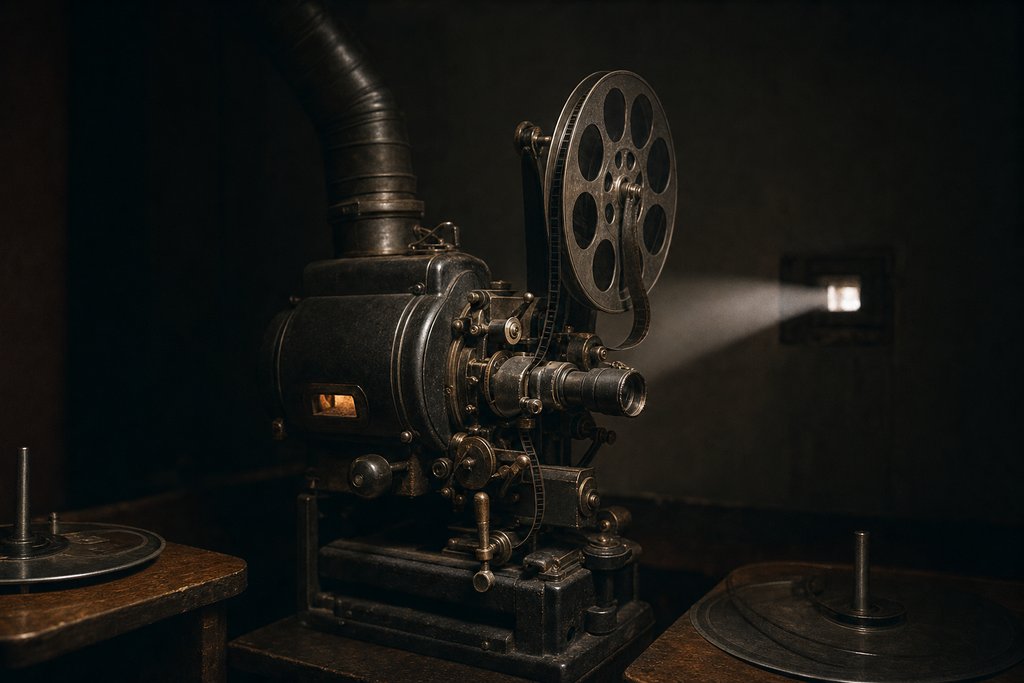
A violinist in the cinema pits
Charles Williams was born in London on 8 May 1893 under the name Charles Isaac Cozerbreit, and worked throughout his professional life under the name he is known by. He trained as a violinist at the Royal Academy of Music.
The career that followed began where a great deal of British light music began, in the cinema. Before sound, a picture house of any size employed an orchestra, and that orchestra played continuously for hours to films it had often not seen in advance. Charles Williams led such orchestras. The job required sight-reading, an enormous working repertoire, and the ability to match music to action in real time, and it trained a generation of British musicians in exactly the skills that the library and film business would want next.
When sound arrived and the pit orchestras were dismissed, those musicians had to go somewhere. Some went into dance bands, some into broadcasting, and some, Williams among them, went into the studios that were now making the music that the pit had previously supplied live.
The film industry
From the 1930s Charles Williams worked as a music director in the British film industry, conducting and supervising scoring sessions and composing to picture.
Film scoring in that period was an industrial process conducted at speed. A composer received a reel with timings, wrote to those timings, and had one session with an orchestra to get it right. There was no opportunity to revise after hearing it, and the schedule did not allow for exploratory work. The premium was therefore on a particular kind of competence: knowing before the session what a cue would sound like, and writing parts that a hired orchestra could play correctly at first reading.
That is the same competence the library business required, and the two halves of his career are continuous rather than separate. It also explains why the film work is barely documented in his name. A studio music director’s contribution is spread across supervision, arrangement and original writing, and the credits of the period do not distinguish between them.
The library catalogues
The largest part of the output went to the publishers’ recorded music libraries, and understanding what that means is essential to understanding him.
A library was a publisher’s own catalogue of recordings, made at the publisher’s expense, not sold to the public and not intended to be. Its customers were production offices: a newsreel editor needing thirty seconds of something martial, a radio producer needing a link, a documentary cutter needing two minutes of unobtrusive pastoral. Firms including Chappell ran substantial libraries, and the catalogues were organised by mood and duration, because that is what the customer was shopping for.
Charles Williams was one of the most-used composers in that system. The volume of work was large, the turnaround was fast, and the payment was reliable. What the system did not supply was any form of public identification, because the product was the recording and the brand was the publisher.
This is the mechanism, described more generally under British light music, that made a whole generation of capable orchestral composers effectively anonymous. Williams is its clearest individual case, because his best-known pieces are more recognisable than any concert composer’s and his name is less known than almost any.
Inside a library session
The operational detail is worth setting out, because it explains the music better than any stylistic description does.
A library session was a fixed cost that had to be spread across as much usable material as the session could produce. A publisher booked a studio and an orchestra for a standard three-hour call, and in that time the aim was to record as much finished material as the call would carry, each of them two or three minutes long and each in a different character. There was no time to rehearse a difficult passage into shape and no budget for a second session to fix what went wrong, so a cue that needed a fourth take was a cue that had cost the publisher money it would not recover. Everything in the writing follows from that: the parts are playable at sight, the ensemble problems are removed before the players see them, and the effects are achieved by combinations that work first time rather than by anything requiring adjustment in the room. A composer who could not deliver that did not get the next commission, and Charles Williams delivered it for decades.
The orchestras themselves were not standing ensembles but pick-up bands of London session players, booked by the fixer for the day. The same faces recur across hundreds of these discs, and their sight-reading is the reason the system worked at all. It also means that a library recording is not attributable to an orchestra in any meaningful sense, whatever name appears on the label, and catalogue names of the type “the Concert Orchestra” or “the New Symphony Orchestra” frequently describe a different set of people on each occasion.
One further consequence is worth noting for anyone dating this material. Because a session recorded a batch of unrelated pieces in one afternoon, the recording dates of items with nothing in common are often identical, while pieces that sound like a matched pair may have been cut years apart. Session date tells you almost nothing about compositional relationship, which is a trap in a repertoire where the session sheet is sometimes the only surviving document.
The two themes
Two pieces escaped the catalogue and became fixtures.
The Devil’s Galop was adopted as the theme of the BBC radio serial Dick Barton, Special Agent in the late 1940s. It is a short, headlong orchestral piece, and its association with the programme was so complete that it has functioned ever since as a shorthand for melodrama and pursuit. It is used that way still, in productions with no connection to the serial, by producers who want the audience to recognise the register instantly.
“Girls in Grey” became the signature tune of BBC Television Newsreel, which gave him a second adopted theme on a second network. Having one piece chosen as a signature tune is luck. Having two, on radio and on television, reflects the fact that his music was in every catalogue a producer opened.
Both cases follow the pattern established with Eric Coates and Haydn Wood. The composer did not write for the programme. A producer chose an existing piece, the association became permanent, and the composer’s name did not travel with it.
The Dream of Olwen
The Dream of Olwen is the exception in the catalogue, and the piece that shows what he could do outside the constraints of a library brief.
It was written for the 1947 film While I Live, and it is scored for piano and orchestra in the manner of the film concertos that were briefly fashionable after the success of Richard Addinsell’s Warsaw Concerto. The film is now almost unknown. The music was published, recorded repeatedly and played on its own for decades, in versions from solo piano to full orchestra.
It is not a concerto and does not pretend to be. It is a single sustained melody given a substantial orchestral setting, and its quality lies in the pacing: the tune is withheld, developed and returned in a way that a two-minute library cue could never accommodate. Given room, he used it.
What the paperwork will not tell you
Library music is the worst-documented category in this repertoire, and the difficulties are worth naming precisely rather than gestured at.
The same recording could be issued in more than one library under more than one title, because publishers traded and repackaged material. Pieces were re-cut to different lengths for different customers, and the resulting versions carry the same title with different durations, or different titles with the same music. Composer credits in the catalogues were abbreviated, and house pseudonyms were used. None of this documentation was ever public, because it did not need to be: the paperwork existed to support licensing, and it stayed with the publisher.
The consequence is that no reliable complete list of Charles Williams’s works exists, and one probably cannot be assembled from public sources alone. If you find a piece attributed to him in one place and to somebody else in another, both attributions may derive from catalogue entries that were themselves inconsistent. The lists in circulation grow with each reissue project that gets access to a publisher’s archive, and they should be treated as provisional rather than as settled.
Death and standing
Williams died on 7 September 1978, aged eighty-five.
His standing is peculiar and probably permanent. Two of his pieces are among the most widely recognised British orchestral music of the century, and both are recognised as functions rather than as compositions: the chase music, the newsreel music. The remainder of a large and skilled output is known to a specialist audience through CD transfers of library discs, discussed under recordings, and to nobody else at all.
There is a case for regarding him as the representative figure of British light music rather than a marginal one. Eric Coates has concert performances and Robert Farnon has the respect of other musicians, but Charles Williams had the career the system was actually built to produce: constant work, wide audience, no name.
Frequently asked questions
Who was Charles Williams?
An English composer, violinist and film music director, born in London in 1893 and active until his death in 1978. He was born Charles Isaac Cozerbreit and worked professionally under the name Charles Williams. He led cinema orchestras, became a music director in the British film industry, and wrote a very large body of music for publishers' recording libraries, which is where most of his output was published.
What is The Devil's Galop?
A short, fast orchestral piece by Charles Williams that became the theme of the BBC radio serial Dick Barton, Special Agent in the late 1940s. It is probably the most immediately recognisable piece of British light music ever written and functions as shorthand for urgency in any British period drama. Very few of the people who recognise it could name the composer, which is the condition of a library career.
What is The Dream of Olwen?
A piece for piano and orchestra written for the 1947 British film While I Live, and the closest thing in his output to a concert item. It outlived the film completely: the picture is now obscure and the music was published, recorded and performed on its own for decades afterwards. It sits in the same tradition as the Warsaw Concerto, film piano writing that escaped its source.
Did he write BBC television music?
Yes. “Girls in Grey” was used as the signature tune of BBC Television Newsreel, giving him a second broadcast identifier alongside The Devil's Galop on radio. Two adopted themes on two networks is a remarkable strike rate, and it happened for the ordinary reason: producers picked from the library catalogues in front of them, and his music was in every one of those catalogues.
What is library music?
Music commissioned and recorded by a publisher, not for sale to the public, but to be licensed to film, newsreel, radio and television producers who need a fixed duration of a particular mood. The catalogues indexed pieces by character and length rather than by composer. Firms including Chappell ran large libraries, and this is the business that the industry now calls production music.
Why is Charles Williams not better known?
Because of how his work was published rather than because of its quality. A library disc went to production offices, not record shops, and the credit that mattered commercially was the publisher's. A producer selecting forty seconds of urgent music had no reason to note the composer, and the broadcast that followed carried no credit at all. Charles Williams was heard constantly and identified almost never.
Did he work in the film industry?
He did, and at a senior level. He conducted and directed music for British studios from the 1930s, which in that period meant supervising scoring sessions, arranging, and often composing to picture under severe time pressure. The work overlapped with the library writing because both required the same skill: correctly timed, immediately playable orchestral music produced to order.
How does library writing differ from concert composition?
In its brief. A library piece has to establish its character within a few seconds, sustain it without development, and be capable of being cut at almost any point, because an editor will cut it. That rules out the long build and the structural surprise. It rewards instead a specific and hard-won skill: making an idea legible immediately, which is why the best library composers were also the most economical orchestrators.
Is his catalogue fully known?
No, and library music is the hardest case in this repertoire. The same recording could appear in more than one catalogue under different titles, pieces were re-cut and re-issued, and the paperwork stayed with publishers rather than in public archives. Attributions continue to be added as reissue projects work through those archives, so any list of his works should be read as provisional.
Where can his music be heard?
The two famous themes are in constant circulation, usually uncredited, as period signifiers in British film and television. Beyond them, the specialist British light music reissue series have transferred a substantial amount of library material to CD since the 1990s, and that is the only systematic route into the rest of the output. Almost none of it is in concert use.
- Sources
- Checked
- REF/CW-001 · 4 sources